


Liberating Structures
DrawingTogether
Reveal insights and paths forward through nonverbal expression. Drawing Together helps people reveal and share their mental models through simple drawings, making invisible assumptions visible and sparking breakthrough conversations. By translating complex ideas into visual form, groups discover shared understanding, uncover hidden tensions, and build alignment without endless debate.

Drawing Together
What is made possible - What it unlocks
Drawing Together creates a safe space where everyone’s perspective becomes visible at once. It bypasses the limitations of verbal discussion, allowing abstract concepts, relationships, and mental models to emerge on paper. Participants gain immediate insight into how others see the challenge, spot patterns they couldn’t see before, and build shared understanding through visual dialogue rather than persuasion.
When to use it
- When you need to surface and compare different mental models or assumptions within a team
- To make abstract concepts, systems, or relationships visible and tangible
- When verbal discussions keep going in circles without reaching clarity
- To help diverse stakeholders understand each other’s perspectives on a complex challenge
- When you want to quickly identify gaps, tensions, or alignment in how people see a situation
- To kickstart strategic planning by visualizing current reality or desired future states
- When introducing a new initiative and you need to understand what people are really thinking
- To deepen understanding after data presentations or reports—turning numbers into meaning

🛠️ The five design elements of Drawing Together
Each Liberating Structure consists of five simple design elements to make participation possible for everyone. By shaping these elements with care, you move beyond rigid control or chaos and create space for people to contribute, listen, and co-create.
- 1. The Invitation
- 2. Setup & Materials
- 3. Participation Flow
- 4. Group Configuration
- 5. Sequence & Timing
How you frame the purpose or question that sets the focus and energy of the group.
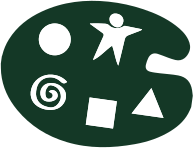
“We’re going to use simple symbols to draw a story about our journey with [challenge/innovation]. You’ll use five basic symbols—circle, rectangle, triangle, spiral, and star person—to create a visual narrative without words.”
The arrangement of space and which tools or resources are needed to support interaction.
- Paper (A4 or larger) for each participant
- Water-based markers; soft pastels if you are feeling colorful
- Wall space to display drawings
- For virtual sessions: digital whiteboard with drawing tools
Who gets a voice and how everyone is actively included in the process.
- Everyone is included since the five symbols are easy for everyone to draw
- All participants make their individual drawings simultaneously
- Pairs or small groups interpret each other’s drawings (drawer stays silent)
- Whole group discovers collective meaning
How people are arranged (alone, small groups, or all together) and how this shifts during the activity.
- Individually to practice the drawing of the symbols
- Individually to make first and second drafts of their drawings
- Small groups of 1–4 others to interpret the drawings
- Whole group for debrief (using 1-2-4-All for large groups)
- Works with any size from 4 to 100+
The step-by-step flow of the activity and the time given to each step to keep energy and focus.
- Introduce the idea of drawing together by drawing and describing the meaning of each symbol (5 min):
- Circle = wholeness
- Rectangle = support
- Triangle = goal
- Spiral = change
- Star person [equidistant cross] = relationship
- Invite participants to practice drawing the five symbols (5 min)
- Invite participants to combine the symbols to create a first draft story about “the journey” of working on a challenge or innovation—working individually and without words (10 min)
- Invite participants to create a second draft, refining their story by dramatizing the size, placement, and color of the symbols (10 min)
- Ask participants to pair up or form small groups. One person shares their drawing while others interpret it—the person who drew stays silent and listens (5 min)
- Ask the whole group: “Together, what do the drawings reveal?” Use 1-2-4-All with larger groups (5 min)
Total time: 40 minutes
Online version
Adapted for virtual use, with the same impact
Although drawing can be done on digital whiteboards, we prefer using real pencils on real paper. You can use your camera to show the drawings, or ask participants to take a photo of their drawing and upload it to the digital whiteboard for everyone to see.
- Introduce the idea of drawing together by drawing and describing the meaning of each symbol. Draw live on a digital whiteboard or show pre-drawn symbols in slides (5 min):
- Circle = wholeness
- Rectangle = support
- Triangle = goal
- Spiral = change
- Star person [equidistant cross] = relationship
- Invite participants to practice drawing the five symbols (5 min)
- Invite participants to combine the symbols to create a first draft story about “the journey” of working on a challenge or innovation—working individually and without words (10 min)
- Invite participants to create a second draft, refining their story by dramatizing the size, placement, and color of the symbols (10 min)
- Ask participants to pair up or form small groups in break out rooms. One person shares their drawing while others interpret it—the person who drew stays silent and listens (5 min)
- In the main room, ask the whole group: “Together, what do the drawings reveal?” Use 1-2-4-All with larger groups (5 min)
Total time: 45 minutes
Order now
All Liberating Structures in 1 e-book
All Liberating Structures (44!) including explanations, visual step-by-step guide, and worksheets in a handy workbook for € 11,-
- Simple methods for big changes
- Have interactions that truly matter
- Build a culture of innovation step by step
- Involve and activate everyone in the group

Proven over decades
🧠 Why it works
Liberating Structures are not magic tricks—they work because they tap into how people naturally think, connect, and collaborate. Each structure is carefully designed to unlock participation, spark creativity, and build trust, using principles grounded in social science and human interaction.
Attribution: Liberating Structure developed by Henri Lipmanowicz and Keith McCandless. Inspired by David Sibbet (The Grove) and Angeles Arrien (see Signs of Life).

Visual Cognition
Drawing activates different neural pathways than speaking, allowing people to access and express tacit knowledge that words can't easily capture.

Simultaneous Reveal
Everyone's thinking becomes visible at once, preventing dominant voices from shaping the narrative before others share their perspective.
Psychological Safety
The "it's just a drawing" frame lowers stakes and reduces performance anxiety, making it easier to share incomplete or uncertain thinking.

Pattern Recognition
When multiple mental models are displayed together, the group's collective intelligence can spot systemic patterns, gaps, and opportunities that no individual saw alone.
Riffs and Variations
Start with creative constraints to learn this structure and then... go liberate yourself and try some variations.
- Before & After: Draw current reality on one page, desired future on another—then compare across the group
- System Mapping: Focus specifically on drawing relationships, feedback loops, and leverage points within a system using the five symbols
- Story Drawing: Draw a journey or process over time, showing key moments and transitions with the five symbols
- Metaphor Drawing: Ask participants to draw a metaphor that represents the situation (e.g., “Draw our organization as a vehicle”) using combinations of the five symbols
- Gallery Walk: Post all drawings on walls and have people walk around, adding sticky notes with observations and questions
- Iterative Drawing: Do a first round, discuss, then draw again with new insights incorporated
- The Observer: One person can visually map conversations during a meeting (add words if you must)
Tips
Lessons learned from other facilitators.
- Emphasize repeatedly that artistic quality doesn’t matter—”Refined drawing skills are not required. Get over your need for perfection! Childlike drawings look playful and capture the imagination of others!”
- Maintain silence during drawing time to prevent groupthink and allow genuine individual reflection
- Display all drawings simultaneously so patterns can emerge visually—ask what’s present AND what’s absent
- Help participants accept whatever emerges in the drawings (there are often surprises)—give people permission to draw abstract concepts
- Draw or present an example of a story that helps others make a leap of understanding
- Record the participants’ drawings with cameras and video recorders, and return to the drawings when you reconvene as a group
- Ask observers to notice which symbols appear frequently and which are rare
- Remember that drawing can be powerfully therapeutic; be prepared for emotional responses
Traps
Don't make the same mistakes.
- Helping too much with drawing skills—let participants find their own way
- Allowing discussion during drawing time—this creates social pressure and limits authentic expression
- Rushing the drawing phase—people need time to think visually, which feels slower than talking
- Having people present to the whole group one by one—this takes too long and loses energy
- Judging or critiquing drawings for artistic merit—this completely misses the point
- Skipping the small group sharing—this is where the real meaning-making happens
- Over-explaining the symbols—let people interpret them intuitively rather than rigidly defining what each must mean
Try it with…
The real power of Liberating Structures emerges when you combine them into "strings." Link different structures together to build on insights and create more powerful results. Here are some nice combinations:
- What, So What, Now What? (W3) after sharing drawings to deepen reflection and identify next steps
- Mad Tea to have rapid conversations about what people noticed in each other’s drawings
- 15% Solutions to generate immediate actions based on insights from the drawings
- 1-2-4-All to progressively build shared understanding from individual drawings
- TRIZ before Drawing Together—draw both “what helps” and “what hinders”
- Wicked Questions to frame the paradoxes revealed in different people’s drawings
- User Experience Fishbowl to explore the drawings through live dialogue and deeper inquiry
Field stories
To get to know Liberating Structures without having used them yourself, it helps to see familiar situations from real-life practice. Chances are that you or your team have faced one of these challenges before. Discover how to approach these kinds of situations in a fresh and engaging way.




free download
Download the PDF explanation
Would you like a clear, well-designed visual explanation of Drawing Together? It’s yours!
"*" indicates required fields

More structures in this category










Download the PDF
Drawing Together
Reveal insights and paths forward through nonverbal expression.
"*" indicates required fields